Apply
Apply to the PhD Program in Political Science
Program Overview:
The PhD in Political Science is a five-year program designed for students pursuing advanced training in political science research and scholarship. Working closely with internationally recognized faculty, students develop the analytical, methodological, and substantive expertise needed for careers in academia, research, public policy, and related fields.
Students select two primary fields of study from five substantive areas: American Politics, Comparative Politics, International Relations, Political Methodology, and Political Theory. In addition, students complete a course-based minor in one of these fields, a graduate interdisciplinary specialization, or a graduate minor offered by the university.
Students may also tailor their graduate experience through departmental specializations in Formal Theory, Political Economy, Political Psychology, and Race, Ethnicity, and Gender, allowing them to pursue focused training aligned with their research interests.
Application Details:
- Application Deadline: December 1, 2026
- GRE Required
- Next Start Term: Autumn 2027
- Apply Now!
Additional Information
Application Requirements
Please Note: All supporting documents should arrive by no later than December 11th.
| Requirement | Domestic Students | International Students | Details |
|---|---|---|---|
| Statement of Purpose | Required | Required | Describe your interest in OSU's Political Science PhD program, your intended focus fields of study, and your career goals. 1-2 pages. |
| 3 Letters of Recommendation | Required | Required | Within a few days of submitting your application, an invitation will be emailed to each reference with a link to our online form. Ohio State does not accept letters of recommendation submitted from third parties. If your reference experiences technical difficulties, they may email their signed letter on business letterhead along with a completed Graduate School Reference Form to gpadmissions@osu.edu |
| CV/Resume | Required | Required | No more than 2 pages. |
| Official GRE Scores | Required | Required | University Code for Test Scores: 1592 |
| Writing Sample | Required | Required | The writing sample is typically a piece of academic writing that demonstrates your academic ability to the admissions committee. This could be a research paper you wrote for a past college class, a thesis you wrote during your undergraduate education, etc. |
| Official Transcripts | Required | Required | Please submit official transcripts from every institution where college credit was earned. Refer to the Graduate School for acceptable submission methods and additional information. |
| Proof of English Proficiency | Not Applicable | Required | Students whose native language is not English (and who have not received a degree from an American university) must provide official IELTS, TOEFL, or Duolingo scores. Additional information about English proficiency requirements and exemptions can be found here. |
Funding
Admitted students are typically offered funding for 5 years. All applicants are reviewed for funding - no additional funding application needed. To be considered for admission and for university fellowships and departmental assistantships, program applications must be received by the deadline of December 1st and all supporting application materials must be received by December 11th.
Funding packages generally include a waiver of tuition and a stipend for living expenses, which increases at each stage in the program. For students making acceptable progress, departmental funding typically continues for five years. Support may be extended beyond five years through awards and fellowships granted outside the university. It is expected that most students will finish Ph.D. requirements within about five years, though students doing fieldwork may require additional study and may petition the department to gain eligibility for more than five years of funding.
Graduate Associateships
- Associateships, awarded for teaching, research, or administration, are the primary source of financial assistance provided to graduate students. Most graduate associateships provide a 12-month tuition waiver, a nine-month stipend, and subsidized health insurance in exchange for 20 hours of work per week for nine months. Associateship positions generally begin in the autumn term and are renewable, depending upon the student’s job performance, grades, and availability of funds.
- To be eligible for consideration, you need only meet the admission and deadline requirements of your program and check the appropriate box(es) on the admission application under "Funding Opportunities."
- Learn more about associateships.
Graduate Fellowships
- A limited number of fellowships are awarded on a competitive basis to applicants who show outstanding scholarly accomplishment and exceptional potential for graduate study. Most fellowship awards pay a monthly stipend, provide a tuition waiver, and subsidize health insurance. Fellowships generally provide twelve months of support for at least one year.
- Read about eligibility criteria for fellowships.
Other Funding Opportunities
- As they progress through the program, some students also obtain support from the Mershon Center, the Political Research Laboratory, and Foreign Language and Area Studies fellowships.
- Advanced students may have an opportunity to teach their own courses.
- In addition, during their program of study, graduate students may support themselves directly through external sources. These include federal aid and loans, sponsorships, and scholarships provided by entities external to the university.
Application Fee Waivers
The Ohio State works with a variety of programs that provide fee waivers to applicants, and also manages several of its own programs. You can learn more about fee waiver programs and check your eligibility here.
International students are not eligible for application fee waivers.
To request a waiver
- Check the box in the Application Fee Waiver section of your admissions application (Ohio State's regular or supplemental application) indicating the program for which you qualify.
- Complete and submit your admission application. You will not be asked to pay the application fee.
- Most waiver programs require additional actions. Select your waiver program from the drop-down below and follow the instructions.
If your waiver request is denied, you will be asked to return to your admission application and pay the application fee. Processing times vary. For most programs, you will receive an email response regarding the outcome of your request within three to five business days.
Frequently Asked Questions
Do I need a master's degree to apply?
A master's degree is not required.
Can I complete a Master's in Political Science at OSU?
Our Political Science graduate program is solely a 5-year PhD program. We do not offer a standalone master's degree. Master's degrees are only available for students who are in our program working towards completing their PhD.
How are applicants reviewed?
Each applicant is reviewed individually on the basis of grades, test scores, recommendations, and the applicant's personal statement. Admission to our graduate program is highly competitive. Students with unique talents and backgrounds are strongly encouraged to apply.
Around 12 funded students, recruited from a large applicant pool, enter each year. Most admitted students have an average undergraduate GPA of 3.73, and highly competitive GRE scores. Approximately 70 PhD candidates are currently enrolled in various stages of study.
When are admissions decisions released?
Students are typically notified of an admissions decision in late January.
Is a personal interview required?
A personal interview is not required though applicants who have been admitted are encouraged to visit the department, so that they can speak with faculty members and current students. We encourage prospective students to contact individual faculty at the addresses listed on the Faculty page to learn more about their research areas.
My letters of recommendation or other application documents may arrive after the deadline. Is this okay?
Yes, supporting documents may be received up to two weeks after the deadline has passed (December 11th).
What funding is available?
Students in our PhD program typically receive funding support for our 5-year program which includes a tuition waiver, health insurance, and a small stipend for living expenses. All applicants are review for funding - no separate application for funding needed. You can find more information regarding the fellowships and funding here: https://polisci.osu.edu/graduate/prospective-students/financial-aid
Can I complete the PhD program as a part-time student?
No, our PhD program is designed for full-time study and part-time study is strongly discouraged.
Can I start the program in spring semester?
No. Admission decisions are made throughout the fall and winter and students enter the program in the autumn semester.
Are Post-Doctoral Fellowships offered in Political Science?
The Department of Political Science does not offer a post doctoral program. However, OSU’s Mershon Center for International Security Studies offers a Post Doctoral Scholar Program. Please contact their department for further information: mershoncenter@osu.edu
Do you accept transfer credit?
We typically do not allow students to use transfer credit to count towards their two fields of study, but transfer credit may be able to be used towards the total number of credit hours required to graduate by the Graduate School. All students must complete two years of coursework and take the candidacy exams at the beginning of their third year.
I only took 4 credit hours at a certain university. Do you still need that transcript?
Yes, any place that you have received credit from, we will need an official transcript.
Do I need to submit a transcript for credit hours I took in high school?
Yes, even if you received college credit for a course completed during high school, we will still require the official transcript from that university or college.
Explore Our Faculty
You can view all faculty by field specialty here. You’re welcome to reach out to any of our faculty directly to learn more about their research. When we review your application, we will look at your interest areas to see if our faculty will be able to support your research.
Program Timeline
Program Timeline
The graduate program in the Department of Political Science at Ohio State is a 5-year PhD program. Terminal master's degrees are not available, however MAs are available for those who are in the program working towards completing their PhD. A typical graduate trajectory begins with two years of coursework in preparation for candidacy exams. Once students pass their candidacy exams in their third year, they move into ABD (all but dissertation) status and can focus on their dissertation.
Year One
We offer incoming students a Workshop on Mathematics for Political Scientists. The workshop is designed specifically with first-year Ph.D. students in mind and has no prerequisites. Its purpose is to refresh students’ memory of, or else introduce them to, basic mathematical concepts and techniques that will prove important in future training and research. Once school begins, first-year students will focus on intro level classes and fulfilling requirements for their chosen major and minor. Many of our first-year students attend ICPSR in the summer between their first and second years. ICPSR provides leadership and training in data access, curation, and methods of analysis for a diverse and expanding social science research community.
Year Two
During students' second year of study, they will continue to take classes and prepare for their candidacy exam, which takes place in the beginning of their third year of study. Additionally, some students use their second year to obtain a FLAS fellowship and participate in language training.
Year Three
Once students pass their candidacy exam in their third year, they move into ABD status and can focus on their dissertation. The department offers a yearlong dissertation workshop during the third year to give students the opportunity to present research ideas and receive feedback from both students and faculty. Additionally, in order to prepare students for teaching, there is a teaching workshop offered in both the summer and the first semester of the third year.
Years Four, Five, and Beyond
By students' fourth year, they will be looking towards putting together their dissertation committee and completing a dissertation prospectus. The department offers a workshop to help students to prepare to go on the job market. Throughout all this time, there are many opportunities to receive grants, do research with faculty, and participate in various programs offered through the university and the government to assist in completing a dissertation.
"I was largely attracted to Ohio State's PhD program for its substantive and methodological breadth and depth as a "big-ten" program. Students receive a broad training when it comes to approaches in international relations, ranging from realism and constructivism to the study of international organizations and institutions, empirical study of war, and even support for critical theory. This broad training pushed me to develop an independent and eclectic research agenda that should ultimately communicate with different areas of international relations. More importantly, the department provides a lot of support for graduate student research--even prior to candidacy--compared to other programs, which makes a huge difference in graduate student outcomes down the road. The program's strength in political methodology also provides skills that set up students for success in academic and non-academic job markets alike. The faculty really go above and beyond to provide students with the intellectual and financial resources needed to succeed." - Maryum Alam, PhD candidate
Time to Degree Completion
People considering a career in political science often have basic questions about their prospective department—questions like, "Where am I likely to end up if I come here?" or "How long am I likely to be here?" or "What are the odds that I will complete my program?" Many graduate programs, surprisingly, either don’t publish that information at all or publish it in disaggregated form as a way of hiding information in plain sight.
Our commitment to transparency begins before students even enroll at our University. Graduate students who are deciding whether or not to choose our program should have the clearest possible answers to these questions. Those answers are below.
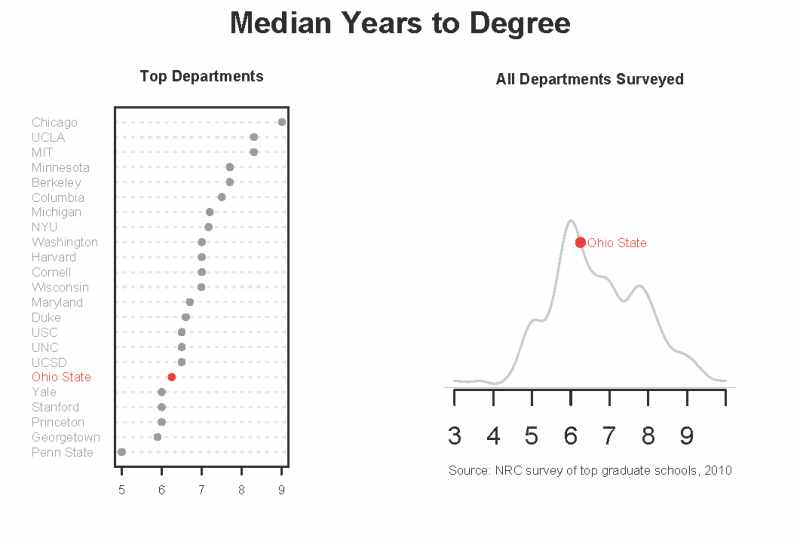
The National Research Council (NRC) cites an average time-to-degree of about 6.5 years in Ph.D. programs in political science. In order to determine where ours fell relative to the national average, we looked at median completion times for all cohorts from 1990 (when the first reliable data exist in our dataset) to 2005 (at which point missing data make the answer unreliable). We also broke the data down by sex of student. The average answer, consistently over time and across the two sexes, generally hovers between six and seven years—a number that corresponds very closely with the national average. It appears that there might be a slight downward trend in recent years, but there are too few students to say definitively whether that is the case.
Median time to Completion
We also broke the same data down by subfield, and here the results are considerably more nuanced. As one often hears, comparativists tend to take longer to complete their dissertations due to the requirements of language classes and fieldwork. Americanists are generally the fastest to complete theirs, and students of International Relations fall somewhere in between. What is most interesting, however, is the fact that, since the late 1990s, time to degree across subfields has converged considerably: the most recent cohorts all show far less variance, completing their degrees in something close to six years regardless of subfield.
Attrition and Completion
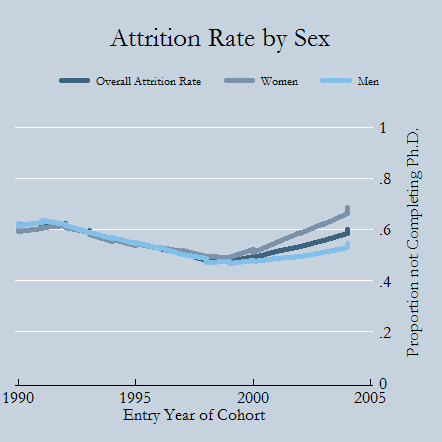 Attrition—whether due to spousal considerations, an attractive career opportunity elsewhere, or personal reasons—is far more common in Ph.D. programs than entering students realize. Many professors tell stories of entering graduate school, being told to look at the students to their left and right, and then being told that only one in three entering students would end up with a Ph.D.
Regardless of the reason, the classical "one in three" statistic is not far off in general for political science programs, nor is it for ours: our actual attrition rate varies widely from one year to the next due to small cohort size, but a smoothed series over time moves roughly between 50% and 60%. (We should note for the sake of comparability that this figure captures all forms of attrition, including simply dropping out and taking a terminal M.A.; in many departments’ official statistics, these figures are disaggregated.)
The Program In Statistics and Methodology (PRISM) provided the research assistance necessary to collect and visualize these data. The Political Research Lab (PRL) created the interactive chart.
Graduate Student Placement
Our graduates have been highly successful in securing positions at major research universities and liberal arts colleges, while others have pursued non-academic careers in government agencies, non-governmental organizations, and the private sector. You can review post graduate placements here.
Living in Columbus
Ohio State students have the chance to live and study in the heart of Columbus, a vibrant world-class city. As the state's capital and largest city, Columbus is one of the fastest growing metropolitan areas in the nation, with a population of nearly two million people.
Columbus offers all the opportunities you would expect from a major metropolitan area: an array of ethnic restaurants; symphony, ballet, and opera companies; world-class theaters and museums and a lively local music and arts scene. It also boasts major-league teams in soccer and hockey, the Yankees' top farm team (the Clippers), and, of course, the Ohio State Buckeyes.
Called a “Midwestern style capital” by the New York Times and one of the top-ten “Best Places to Live” by Money Magazine, Columbus is second only to Boston for the number of college students. Nearly half the population falls within the 18-44 age group, making Columbus a great city for students and young professionals. As Ohio’s capital city, Columbus’ ties to government, business, and industry provide a wide array of career and research opportunities for Ohio State students both before and after graduation. In fact, Gallup rates Columbus the No. 2 metropolitan area for jobs, and we enjoy the second-highest employment rate in the country for young adults.
Columbus has been named:
- No.1 up-and-coming high-tech city (Forbes)
- Top ten most livable city (CNN/Money Magazine)
- Top 25 LGBT-friendly campus (Campus Pride)
- No.1 best place to live, work and raise a family for African Americans (BET Networks)
- The most intelligent city in the United States (Intelligent Community Forum)
- One of the best U.S. cities for Millennial college students (USA Today)
- Top-20 best U.S. city for young professionals (Forbes)
For a closer look at daily life in Columbus, visit Experience Columbus on Instagram
Check out Columbus Underground's list of the Top 20 Things to do in Columbus
Additional Questions?
Questions about the structure of the PhD program, curriculum, or other academic matters should be directed to Professor Amanda Robinson, Director of Graduate Studies.
For all other admissions and application-related questions, please contact Graduate School Admissions.